Thursday, 27 April 2017

Mid April

As April progressed the seeming early start to spring was halted when the wind veered to the north-north west and remained there, almost unchanged, for a fair few days.
Things changed ever so slightly eventually and gave me all the inspiration I needed to get out, well at least for an hour or two on Castle on the 8th in the hope of mopping up any migrants that had battled north during the small window of opportunity. Realistically I was hoping for a Willow Warbler at best – failed on that one, but I did head home surprised. A migrant I wasn’t entirely sure I would even come across in my PWC area, even in the peak times in June etc, never mind in April!
Whilst stood on the south side, overlooking the area behind the water treatment centre along Marine Drive a Quail flew towards me up the bank side, over the top of me and then dropped back in!
Whether this bird had been flushed (maybe by a Fox?) or had just arrived in off is a mystery.

Other than that the first 10 days or so of the month produced more expected additions, Yellow Wagtail, Willow Warbler, Whimbrel etc while Goosander (a female) finally made an appearance for me.

The Shorelark flock remained at Long Nab – appearing after another few day’s absence.
Over the sea on the 12th Manx Shearwater and 2 Puffin were additions for the year while 16 Sandwich Tern was the largest number of 2017 to date.
Later that day, whilst at Scalby Mills a 2cy Glaucous Gull flew south at sea and continued past Marine Drive. A quick message to Steve, comfortably in his ‘obs’ in South Bay overlooking the Harbour meant he soon picked the beast up coming in and dropping into the Harbour. I couldn’t resist a better look, unfortunately picture opportunities weren’t great in a cold wintry shower.


Male Stonechat on the end of Long Nab.
A fresh in male Wheatear on the end of Long Nab.
Glaucous Gull in the Harbour.

Late March - early April

By 29th March another typically early migrant made landfall at Long Nab and was added to the growing year list, a Wheatear in fields just north of the hut, soon followed by a further two just a little further north at Hundale Point.
At least nine Shorelark remained also.
Another year tick came in the form of some real #patchgold – a Red-legged Partridge on the entrance road just near Clifftop House.
Other than that things remained rather quiet, as they did the next day, the only real difference being two White Wagtail by the Cover Crop.

April began well up at Long Nab with that real feel of spring about it. Starting out early the first two hours proved interesting with a push of passerines south along the cliffs before the wind dropped a little and all but killed the action, still the mornings highlights came out at 53 Meadow Pipit, 1 Greenfinch, 115 Linnet, 22 Goldfinch and 2 Siskin south.
The sea was, as expected, quiet although 11 Whooper Swan north early doors were a nice surprise.
A good walk around didn’t result in much, at least 13 Brambling were still in the ringing site, a ‘few’ Shorelark were scattered around the fields and Chiffchaff numbers had increased slightly.

Deciding to leave Long Nab and head south a final check of the inland ridge revealed a Red Kite heading north.
Cromer Point pond held a drake Garganey – one of the Johnson’s Marsh birds out on a wander, while close by a Bar-tailed Godwit was with a few Curlew and a Swallow passed south in the company of a Sand Martin.

Further south still at least 15 20 Sand Martin were now in the Scalby Nab – Jackson’s Bay area and two Sandwich Tern were feeding of Scalby Nab


Wheatear, Meadow Pipit and Chaffinch at Hundale Point.
Chaffinch at Scalby Mills

Saturday, 15 April 2017

Early to mid-March

Typically March has been slow to get going.
Signs of spring were slowly developing – Skylarks now singing everywhere, clear outs of various Buntings and Finches, regular waves of Snipe staging along the cliffs before leaving as well as increases in Pipits, Wagtails and Finches moving which brought with them my first Siskin of the year.

Early in the month a Great Crested Grebe in North Bay was an addition to PWC – strangely having missed them up until now.
Small numbers of Goldcrest and Chiffchaff began to appear along the coast and the Shorelark flock remained at Long Nab with a maximum count of 17, although numbers began to drop during mid-month.

The small flock of Brambling in the ringing plantation began to dwindle in number while a Water Rail was seen in the ditch there on the 1st.
Things really did start to get going during the middle of the month with spring now in touching distance.

Its always a pleasure to see that first real summer migrant, and it was no different when on the 14th a Sand Martin shot into view, hawking up and down over the Cromer Point colony.
In the fields behind me were three littoralis Rock Pipits looking rather nice. Movement along the coast also began to pick up with Meadow Pipits and Alba Wagtails predominantly moving north with Finches, mainly Linnet heading south with the occasional Goldfinch, Chaffinch and Siskin mixed in.

Not to miss out on the recently reported large scale Redwing exodus I had a few flocks heading east after work early morning on the 15th.
Late that morning, a quick check of Johnson’s Marsh on route to Long Nab was very successful and produced four ugly Egyptian Geese.

Egyptian Geese on Johnson's Marsh.

Up at Long Nab it was a generally quiet day, a trickle of Meadow Pipit and Linnet were headlined by 2 Siskin!
At least 8 Brambling and 3 Goldcrest were in the ringing plantation and 5 Shorelark remained by Crook Ness.

Shorelark at Long Nab.

Johnson’s Marsh delivered the goods yet again on the 22nd with not one but two cracking drake Garganey providing a very pleasant surprise on my way up to what became a very quiet outing at Long Nab – again!

Drake Garganey on Johnson's Marsh.

February

All in all February was a decent month, 14 species added to PWC as well as my first bit of birding outside of Scarborough – to Spurn.
Once my old stomping ground, embarrassingly this was my first trip here since the major breach along the peninsula, a good few years ago.
A short but great trip was enjoyed during the middle of the month, catching up with a few familiar faces, seeing some of the many changes, a pint or two in the Crown and Anchor and of course a few birds – highlights being a female Scaup on Beacon Ponds and the Black Brant with Brent Geese along Long Bank.

Brent Geese at Long Bank, Spurn.

Back in Scarborough the months highlight came on the first day, a Leach’s Petrel heading north over a calm sea off Scalby Mills – a rather unexpected record. Only my 4th in Scarborough with all the other three falling in September.
Most other PWC additions were run of the mill - Mistle Thrush, GadwallLesser Black-backed Gull etc. Goshawk displaying over Raincliffe was a handy year tick as was a Jack Snipe at Long Nab and four Corn Bunting with Yellowhammer near Scalby Lodge Pond.
A drake Goldeneye on Johnson’s Marsh was welcome with possibly the same bird seen the next day flying round at Long Nab.

Wigeon at Scalby Mills.
Dipper at Scalby Mills.

Other highlights included my 2nd of each Black-throated Diver and Lapland Bunting for the year and the regular appearance of the Shorelark flock at Long Nab.
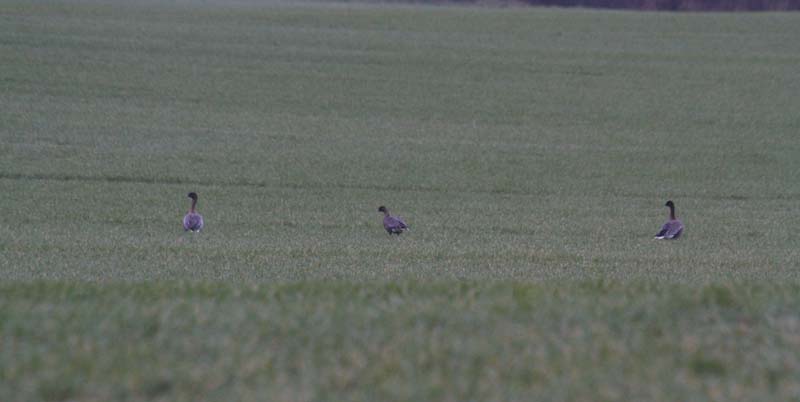
There were plenty of signs of spring creeping in towards the months end with Pink-footed Geese heading back north as well as Pipits, Alba Wagtails and Finches all starting to move.


Shorelark at Long Nab.
Pink-footed Geese on the move north at Long Nab.

Thursday, 9 February 2017

January caught up...

Since the Glauc fest on the 14th things haven’t slowed down much, the brilliant birding this January has continued.
It didn’t take long for the next goodie to pop up either, just a day in fact, late morning on the 15th I found myself at Long Nab enjoying the 16 strong flock of Shorelark despite the grim weather.
Almost certainly the same flock present last year, last being seen in early December – presumably having spent the last month or so in fields further inland and not accessible.

Shorelarks at Long Nab.

Another addition to my PWC effort later that day was a Black-throated Diver out in North Bay.
The Stonechat and one Black Redstart were still preforming well in North Bay and the 2 Great Northern Diver and a Black-necked Grebe were in the Harbour.

The 18th didn’t disappoint either, with eight species added to PWC. Collared Dove and Barn Owl eventually fell while a few others were a little more noteworthy.
Three Pink-footed Geese were present at Long Nab early on before leaving north, 2 Brent Geese and 8 Shelduck flew north at sea, a Lapland Bunting was with Skylark in the stubble field as well as a Tundra Bean Goose that left to the south. Two north bound Great Northern Diver were also noteworthy along with 35 Red-throated Diver heading north, at least 11 Red-throated Diver were present there on the sea with several regularly calling.

Pink-footed Geese at Long Nab.

Whooper Swan at Scalby Lodge pond was a welcome addition on the 19th – it stayed put until at least early February.
The 25th at Long Nab produced at least 15 Brambling in our ringing plantation as well as 50 Reed Bunting and 25 Yellowhammer in the cover crop – a good 20 minutes searching there failed to produce the hoped for Pine Bunting!
Later that day I connected with the fine drake Red-breasted Merganser in the Harbour.

The following day saw the Red-breasted Merganser and a Black-necked Grebe in the Harbour as well as 3 Shoveler south offshore along with small numbers of Wigeon and Teal.

Drake Red-breasted Merganser in the Harbour.

A Tawny Owl heard at Peasholm Park at 01.00am after work on the 29th took me to 97 species – touching distance of my target of 100 for January.

Later on the 29th, as dawn broke, I made my way to Long Nab, it was to be my last day in the field this month due to work.
Species number 98 came along rather quickly, a single White-fronted Goose south with 6 Greylag Geese shortly followed by another 16 White-fronts south over the sea.
A Little Egret south there was a rather unusual but welcome record for January and species number 99.

Grey Partridge became the milestone species with a few calling away by the stubble field.
Heading south highlights included a Tundra Bean Goose with 3 Pink-footed Geese and 2 Greylag Geese in flight over Cromer Point, having earlier being seen by Crook Ness, and 20 Golden Plover north. Number 101.

What was probably my 14th attempt of the year at Scalby Beck for Dipper finally resulted in success, species number 102 for January!

I finished my day around the Harbour, the 2 Black-necked Grebe were showing nicely in the Harbour mouth while South Bay was pretty active, 2 Great Northern Diver, 2 Red-throated Diver, 5 Common Scoter, 2 Long-tailed Duck, a Mute Swan and a scattering of Guillemot and Razorbill.


Black-necked Grebes in the Harbour
The male Stonechat continued to show well in North Bay.
Both Black Redstarts also remained in North Bay.

Thursday, 2 February 2017

Glaucs galore!

The 14th began slowly for me, I started off by walking north past the Harbour and along Marine Drive, in that time I saw more damage to the seafront than I did birds.

North Bay from Marine Drive.

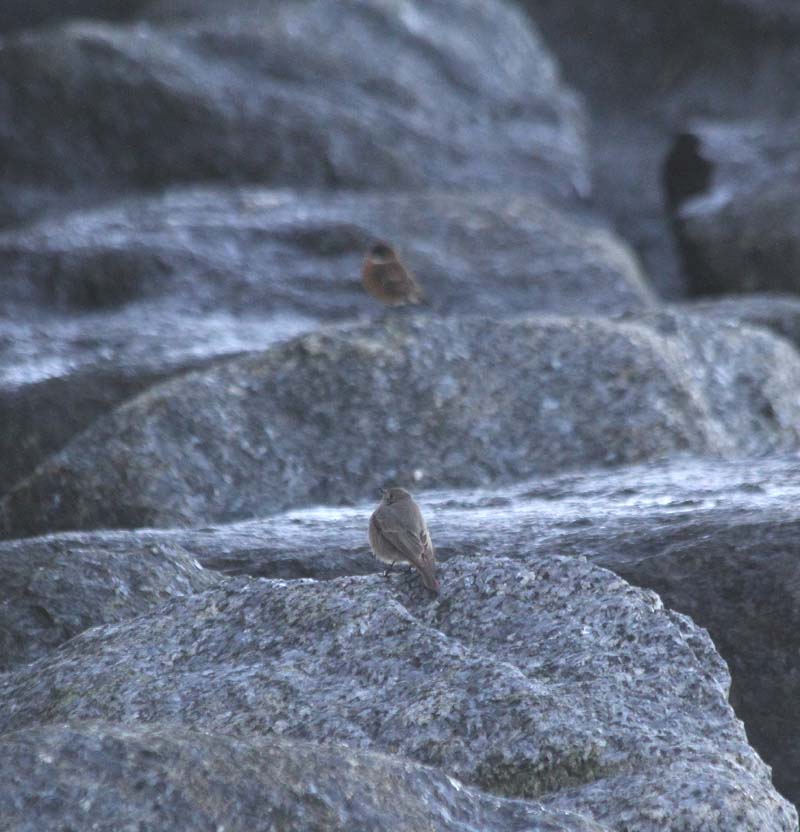
The extent of the tidal surge in North Bay was evident, so to see that both female Black Redstarts and the male Stonechat had survived was brilliant, all three of which were feeding actively in the usual spot, the sea defence rocks opposite Oasis café.

Black Redstart and Stonechat.
Stonechat.
Stonechat and the Sands.
Rock Pipit.

From there I headed north to Scalby Mills, immediately locating a 1st winter Iceland Gull – a perfect start.
Unfortunately, due to the wisdom of a certain dog walker, all the Gulls were flushed as he walked right out among the rocks!
A little after Dave joined me the Iceland returned.
Soon after the action really started. I picked up a 1st winter Glaucous Gull coming in from the east, it landed on the sea briefly before flying off north east out past Scalby Nab.
A small crowd soon assembled and shortly after another Glaucous Gull was picked up, towering high circling round a little before heading off north after a short drift south.
Only minutes later what turned out to be another Glaucous Gull came round Marine Drive and flew north through the Mills!
Not too surprising considering three had flown north past Cornelian Bay in a little over and hour at the same sort of time.


Phonescoped record of the Iceland Gull.
Glaucous Gull.
Glaucous Gull.

A short while later, whilst eating at the Oasis café, after second helpings of the male Stonechat, a 1st winter Glaucous Gull flew south over our heads, seemingly with some rather different plumage features to the others seen previously.
With the day already going brilliantly (even better with a bacon and sausage sandwich in hand) another Glaucous Gull buzzed over, this time an adult!
Unfortunately it was a little high as it headed north towards Scalby Mills, later being seen passing there and Jackson’s Bay.

Glaucous Gull.
Adult Glaucous Gull.


Fairly gob smacked, I along with Dave headed round to South Bay – the long way round as the Marine Drive was still closed due to the clean-up operation.
Once at the Harbour the two Great Northern Diver were soon located, at least seven Cormorant and five Shag were sheltering in the Harbour too.
In the outer Harbour both Black-necked Grebe were showing while in South Bay a single female Common Scoter was the pick of a small bunch.
Five Purple Sandpiper were already in along east pier despite high tide being 4 hours away, it really was rough!

Great Northern Divers in the Harbour.
Shag - FCZ ringed as pullus on Isle of May on 6th June 2016.

A short sea watch here produced a couple of Red-throated Diver north as well as, yes, another Glaucous Gull!
This time an age day tick, a 2nd winter bird.
With a day total of six Glaucous and one Iceland, as well as a nice supporting cast, I returned home incredibly happy, and in all fairness, it’s probably hands down the best January days birding I have ever had in Scarborough, and with some great company too.

Tuesday, 17 January 2017

January update

Now that the first 24 – 48 hour tick fest is over I’ve been working a little harder to squeeze out every PWC tick available, and although things have obviously slowed I’ve added about 20 or so since, leaving me on a respectable 82 as of the close of play on the 14th. Of course there are some easy ones left, Sparrowhawk and Collared Dove are the first two that spring to mind.

I’ve managed seven days in the field since the 4th, most of which have been slow sea watches at Long Nab.
There have of course been the odd highlight, best of which was a 1st winter Iceland Gull south there at 08.54hrs on the 4th.
A 1st winter Glaucous Gull flew south there at 09.20hrs on the 10th, presumably the bird that’s been hanging around at Scalby Mills, which I watched from the comfort of the Pub there on the 4th.
A couple of drake Eider south on the 10th were also rather welcome.

Predawn start at Long Nab on the 4th, looking south to Castle Hill.
Castle Hill with an incoming wintry shower on the 4th.
One of two Great Northern Divers in the Harbour.
Other additions have included Snipe, two have been present regularly, one at Long Nab and one at Cromer Point and a couple of Lapwing at Scalby Mills on the 10th.
The rest have been standard run of the mill species, SkylarkReed BuntingStock Dove etc.
I obviously had a rough target of species I intended to pick up by the end of January, so on the 12th adding 4 PWC tick, three of which I wasn’t ‘expecting’ was very welcome indeed.

After finally nailing Buzzard, three distantly over Cloughton, I bumped into a Chiffchaff on my walk south, in the Style Scrub – which eventually moved to Trough Gully. Also there was a Grey Plover and 2 Dunlin in Jackson’s Bay.

Looking north at Long Nab on the 12th.

Still, all in all the birding had been pretty typical for January, although things definitely changed.

The 13th saw some intense northwesterly winds hit us bringing with it some big seas and some serious tidal surges causing plenty of damage along the seafronts of North and South Bays.
This severe weather forced plenty of white wingers south as evident by the reports during the afternoon and evening of the 13th.
It wasn’t until the 14th that the number of white wingers about became evident. And the 14th is a true contender for my best winters day birding in Scarborough.