Tuesday, 29 August 2017

Perseverance pays off.

The day after the Rosy Starling (14th August), I was up in Hundale, Long Nab early doors with Chris for a mornings netting.
Not too surprisingly it was quiet, a few locally bred warblers and a fine juvenile male Sparrowhawk were the highlights.
Movement over the sea (and to a lesser extent over land) was much more interesting, unfortunately much was missed while out on net rounds or processing the catch, however in between we managed to amass a fairly respectable number of species, highlights were a juvenile Marsh Harrier, five Eider, three Pintail, six Ringed Plover, one Knot, 56 Dunlin, an adult Curlew Sandpiper, 99 Redshank, 12 Black-tailed Godwit, an Arctic Skua and eight Flava.


Sparrowhawk.

Several quiet days followed, until 23rd when things picked up, a morning session off Marine Drive was very entertaining with an adult Pomarine Skua and a nice close Balearic Shearwater making up for the first light start. The supporting cast of 99 Fulmar, 288 Teal, 101 Common Scoter, nine Sanderling, eight Arctic Skua, 3 Bonxie and 53 Common Tern kept interest high throughout.
Later that morning, up at Long Nab several more Arctic Skua were logged while Teal were still trickling by with two Tufted Duck in with them and a long awaited PWC tick in the form of a Greenshank north along the cliffs.
With the southeast wind I had wanted to check Cromer Point pond in the hope of finding an Aquatic Warbler, a choice I would ultimately regret!
I did kick a Sedge Warbler out the rank grasses by the pond, however shortly after the heavens opened and dropped the heaviest rain I have definitely ever been caught in, by some margin!
Within a minute I was soaked to the skin (four layers including a rain coat!), I tried to take shelter up against the wall of the sewage works but this provided no rest bite from the wall of water, shortly after realising I physically couldn’t get any wetter I focused my attention solely on protecting optics and camera, an exercise ultimately futile as my camera packed in!

I spent a few days rather fuming about my camera however it did dry enough and luckily began to work the day before our final Scarborough Birders pelagic of 2017.
So, early on the 27th August I found myself down in the Harbour and boarded the Queensferry with 23 others. In the past these trips haven’t really produced anything too interesting, however today, on I think our 7th trip, we made up for that with some nice close encounters of species usually seen at range from Long Nab.
Highlights were four Arctic Skua, one of which put on a great show harrying Kittiwakes and Common Terns just by the boat, a couple of Bonxies, three Manx Shearwater, including a close feeding bird, many Common Terns and Fulmars streaming north and a fine Balearic Shearwater, that put on a nice show before flying off south.
A short fishing trip was also enjoyed by many with plenty of Mackerel and Whiting caught, I couldn’t resist a quick go and bagged a few Mackerel myself!


A nice crisp looking young Great Black-backed Gull.
Fulmar.
Fulmar.
Manx Shearwater.
Arctic Skua hammering a juvenile Kittiwake.
Adult Common Tern.
Juvenile Common Tern.
Balearic Shearwater.
Balearic Shearwater with a backdrop of Castle Hill and the Harbour.
This Red Kite (and 2 Common Buzzard) was a bonus heading south over the Harbour after the trip.
Success!

Monday, 28 August 2017

Pink Stink

The end of July – beginning of August has been rather routine, an increase in Skuas, the first Sooty Shearwaters of the year and waders moving in fairly good numbers, 361 Knot south on the 26th (smashing the previous Scarborough record by over 150!!) was brilliant, with a supporting cast of 9 other species, including five Black-tailed Godwit and even a Ruff, noteworthy for Long Nab.

Bonxies passing Long Nab.
Common Scoter past Long Nab.

Hirundines have started to leave south, particularly Sand Martin with 93 through Long Nab on the 31st, with two Storm Petrel trapped at Crook Ness that night during the last session of the year.
Predictably the bulk of the Swifts have moved out during the first few days of August, however, 63 over the house on the 8th was a nice late summer sight, which kept me busy for an hour or so checking through them thoroughly.

Yellow Wagtail at Long Nab, several starting to move around now.

Some interesting winds looked promising for an early Autumn sea-watch for the 8th but unfortunately it never amounted to much, the ‘highlight’ being a large Shearwater (a Cory’s no doubt) that went north past Long Nab on the 10th, but it was unfortunately very distant and came through during very glary conditions.

It was however a Rosy Starling that stole the show and kicked off the autumn in style, with news first released on the 13th (although it had evidently been present for several days previous) I was ‘disturbed’ as I made myself comfy in the Pub in the hope of watching some football, however I was very quickly on site and was rather happy to add this stunner to my Scarborough list, now at 256 in five years!


Several shots of the Rosy Starling.


Saturday, 22 July 2017

Hotting up for autumn...

July, a month most turn their attentions to waders, and in time sea birds.
The sea bird side of things is all okay here, in a North Sea sense, it’s just the waders that become the issue – in short, Scarborough is shite for waders!
Plenty can be seen passing off shore in ideal conditions but having the opportunity to search through good numbers and potentially find something rarer is pretty much out the question.
Sure there are a few areas along the coast that do get very, very small numbers, double figure Dunlin if one is lucky!

From the beginning of the month until the 22nd I have been spending most of my time either looking out to sea, attempting to catch Storm Petrels or strimming and other maintenance work on Johnson’s Marsh (to try and tempt a few waders down, as yet unsuccessfully) and around Hundale at Long Nab in preparation for the autumn ringing campaign.

Up to 14 Grey Heron on Johnson's Marsh during the month, here before our efforts to improve wader habitat and viewing etc.
After some back breaking strimming....
...lots of back breaking strimming!

The Pelagic on the 9th was entertaining if rather predictably quiet, and smelly!

Quiet on the bird front but some nice views of the Scarborough coastline from the Pelagic. Here Castle Hill.
Long Nab.
A birds eye view of the Nab hut.
Plenty of Auks seen, including this Razorbill.
And Puffin.
A few Gannet came in close.
As well as plenty of Fulmar.
This juvenile Kestrel was picked up steaming towards Britain while at least two miles out, birds already coming in off the continent.
It wasn't just the Kestrel seen coming in, one of two Red Admiral seen from the boat while a few miles out, several other insect species also.

Highlights over the three weeks have included a good Common Scoter count (in fact the record count for the Scarborough area) with over 2200 north on the 6th as well as a few waders south.
A failed Petrel ringing session due to torrential rain was followed a week later by a successful one, bagging a single bird.
A juvenile Yellow-legged Gull in Jackson’s Bay on the 12th, and an increase in most seabirds - Manx Shearwater and Arctic Skua most notable.
A morning at Long Nab on the 19th had a real feel of autumn to it and that the cogs were turning, over 80 Manxies, a ‘BlueFulmar (as well as over 90 light), a load of waders as well as a tally of 6 Arctic Skua.

Our first attempt at Petrel ringing of the year called off due to torrential rain that flooded Crook Ness making access to the beach impossible.
A week later and the Petrel ringing evening was a success. This picture taken from the exact same spot as the one above.
A single Stormie trapped. Photograph take by Chris Bell.

Rather unexpected was this Badger seen running through a recently cropped field at Long Nab at 11.35hrs on the 19th. I don't think I have ever seen a picture of a Badger quite like that!
Of interest, this Great Egret that was present on Johnson's Marsh on the 21st June was ringed as pulli at Lac de Grand-Lieu (Loire, Atlantique, FRANCE) on 8th May 2015. It was seen at several sites in France during 2016 but this was the first sighting in 2017.

Tuesday, 4 July 2017

The doldrums of June.

The beginning of the month didn’t inspire me too much, with very little turning up elsewhere along the Yorkshire coast my time spent out in the field dropped.

A few hours here and there were fairly routine, much of my time out was spent tracking down Starling flocks in the hope of pulling out a Rosy – no joy.

An Arctic Skua was a welcome year tick off Long Nab on the 15th with over 600 Swift, a few Common Scoter and a Little Egret through that day adding some extra interest.

Little Egret through Long Nab.

An early sea-watch on the 21st, starting out at 04.35hrs, was as expected slow, however four Tealfour Curlew and two Oystercatcher gave hints that autumn was approaching.
The first decent Puffin count in Scarborough of 2017 was also noted, 106 south, seven north over a four hour watch.
In the hope of stumbling across a Marsh Warbler, a Rosefinch or something much rarer, I turned my attention to walking the hedges and fields along the cliffs. Unfortunately though the grass pollen had other ideas and I couldn’t take more than an hour or it.

A stop at Johnson’s Marsh on the off chance produced eight Grey Heron and ,to my surprise, a Great Egret, a colour ringed bird too! And although I haven’t heard back on its origins yet, some research points strongly towards this been a French bird.

Great Egret on Johnson's Marsh.
Great Egret at Johnson's Marsh.

That evening was spent passing the time in a way I am not particularly keen on, nor too knowledgeable on but with good company and the promise of a pint or two afterwards I was tempted to look at insects and plants!
Marbled Whites were pleasant enough to see, only the second time I have seen them to my knowledge, as well as three Orchid species – PyramidalCommon Spotted and Bee.

Marbled White.
Common Spotted Orchid.
Pyramidal Orchid.
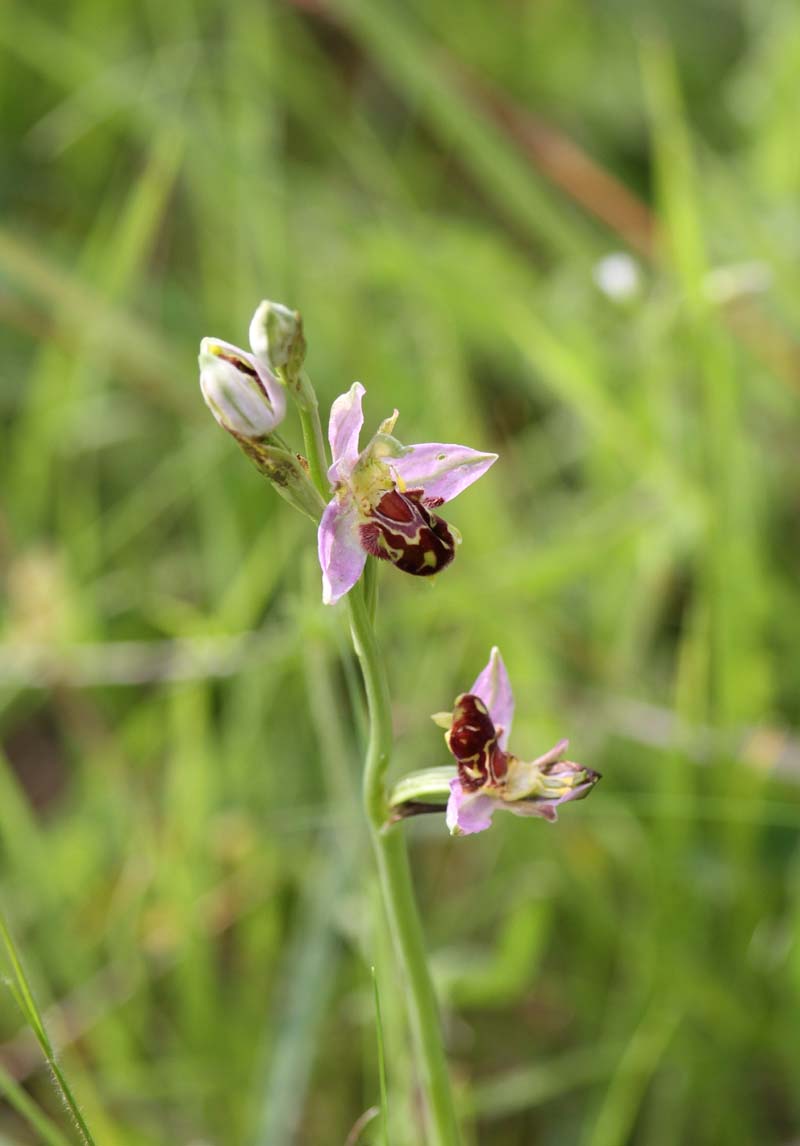
Bee Orchid.

June came to an end about as spectacularly as it began. Some southwest winds have tempted me out in the hope of some big Swift days, each time a total failure with barely double figures through in perfect looking conditions!

A Scarborough Birders AGM at the Downe Arms, Wykeham was concluded with a short trip up in to the forest where several Woodcock as well as a couple of Nightjar were year ticked.

Finally the 29th was a morning spent at Long Nab hoping the BBA would pass by, unfortunately though it seems it did the evening before! Thick fog made for a short unspectacular watch, a few Teal, 14 Manx Shearwater as well as the first returning Redshank, seven north were the highlights!


Showy Eider at Scalby Mills during the end of the month.

Friday, 2 June 2017

And still the good birds come...

The good spell for Long Nab continued on the 22nd. Typically the day had that feel to it that the spring migration was largely fizzling out, at least in terms of common migrants and volume of vis-mig etc.
A slow trickle of Hirundines kept the interest from the off with ten Barnacle Geese south at 07.00hrs (seen by Brett past Flamborough 56 minutes later) and a Little Egret south mid-morning adding some extra interest.

Little Egret south through Long Nab.

Whilst at the obs (the former Coastguard lookout) the Coastguard arrived!
As they were looking for something suspicious washed ashore I offered my help in searching and began to scan the shoreline – to no avail.
Although whilst doing this, as I was up by long hedge north of the obs the call of a Bee-eater caught my attention.
At the time I happened to be messaging Chris who was down the coast at a quiet Bempton Cliffs and at first I dismissed the call. But after another ‘purrt’ call I began searching the skies, above my head initially as it sounded as though it was directly above me.
It turned out it wasn’t, as it continued to call I widened my search area and after a couple of false alarms with the odd Swift I finally locked on to the unmistakable shape of a BEE-EATER!
Switching to scope I watched it continue south with four Swift!
A much desired find tick made even better by it being on patch.

The following few days were quiet (not that I was complaining at all) and I again gave Castle Hill some attention, again drawing a blank.

The 25th was the start of a few days planned ringing sessions up at Long Nab with Chris. Typically slow going on the first day although an acredula type Willow Warbler trapped was interesting. Passage was barely detectable although a Siskin north was my first for some time.


The acredula type Willow Warbler at Long Nab.
Chiffchaff at Long Nab

The 26th was a little better, the first Sedge Warbler to be ringed at Long Nab was very welcome whilst another Willow Warbler on site gave hints that small numbers of migrants were arriving in the southeast winds.
Short-eared Owl was also in the Long Nab area hunting the field early morning.
Passage was a lot better compared to the previous day with 38 House Martin97 Swallow and 25 Swift south the highlights.

Sedge Warbler at Long Nab.

The 27th, our final day of ringing planned, proved to be incredibly quiet at the start. In fact no presumed new in migrants were noted in the ringing site all day!
Vis-mig was slow with very few Hirundines left moving. Swifts threatened to get going but only reached 58 with most restricted to the first hour or two, they just fizzled out after that.

As the heat increased and with little happening we had to keep motivated. After a blank net round we arrived back at the car and began to scan around, hoping to mop up any passage Swifts we may have missed – there weren’t any!
However a Falcon heading slowly south past the middle plantation being harried slightly by a Carrion Crow had drawn the attention of both of us.
As it dropped low and was against a background it was evident it wasn’t a Kestrel!
As I turned for the scope, Chris did the same with his and followed it by ‘’this looks like a Red-foot!’’.
Both on it – it carried on flying low and proved to be a fine female RED-FOOTED FALCON!!

As it disappeared behind the cow sheds at Fields Farm we presumed it landed on the wires as we didn’t detect it appearing on the other side.
Cameras grabbed we began ‘running’ uphill towards the farm.
Arriving there it was clear it hadn’t landed on the wires! I scanned the hedges in the area, not expecting any result, when I came across the unmistakable orange underparts! There it was, sat up nicely! Wow!!!

I couldn’t believe my luck, this May had been incredibly kind to me!
Time of locating this bird was 08.50hrs and after a few pictures were taken attentions soon turned to getting the news out and calling the locals!
It looked settled and with a few on the way it seemed likely that it would play ball.
That was until 09.05hrs when it lifted and flew lazily south, towards Rocks Lane and disappeared out of sight.
It was our opinion though that it hadn’t gone far and there was still plenty of hope that the observers arriving on Rocks Lane would relocate it. Unfortunately it wasn’t seen again, at least at Long Nab.
A female Red-footed Falcon west past the Wykeham Raptor Viewpoint at 10.30hrs could have easily been the same bird. Who knows?

After that the day kind of faded, things were still slow, it was hot and not too long later we packed up. That afternoon a few beers and the FA Cup Final were a perfect way to celebrate the awesome spring – that isn’t over yet….


Red-footed Falcon at Long Nab.
Phonescoped Red-footed Falcon at Long Nab.
And again...